Originally published in The Spode Society Review, Fall/Winter 2026.
By Paul Lanning
Like many American Spode collectors, my journey began with Christmas Tree.
Today, it is difficult to imagine a time when Spode Christmas Tree was anything other than ubiquitous. For generations of Americans, the familiar green tree, presents, ornaments and sprigs of holly have been as much a part of Christmas as the decorations themselves. It was certainly my introduction to Spode.
My collecting interests eventually moved well beyond Christmas Tree. I discovered the extraordinary range of Spode and Copeland transferware and began acquiring pieces in patterns, colors and forms that were considerably older — and sometimes considerably more difficult to find.
In the years since, that collecting impulse has only grown. My cabinets now hold Spode spanning nearly two centuries of production — early nineteenth-century pieces alongside patterns produced as late as the 1980s and 1990s — and a correspondingly wide range of forms, from serving platters and covered tureens down to the smallest condiment dishes.
Somewhere along the way, I developed a particular affection for one of the smallest forms Spode produced: the butter pat.
A collector’s fascination in miniature
At approximately three inches across, butter pats don’t command much space in a china cabinet. Perhaps that is part of their appeal. They provide an opportunity to collect an extraordinary variety of Spode patterns and transfer colors without acquiring another dinner service — although that has certainly never prevented me from acquiring larger pieces as well.
Over the years I assembled dozens of Spode butter pats. Tower, Camilla, Italian, Old Salem and other familiar patterns appeared in different colors and periods of production. Taken together, they became a miniature survey of Spode transferware.


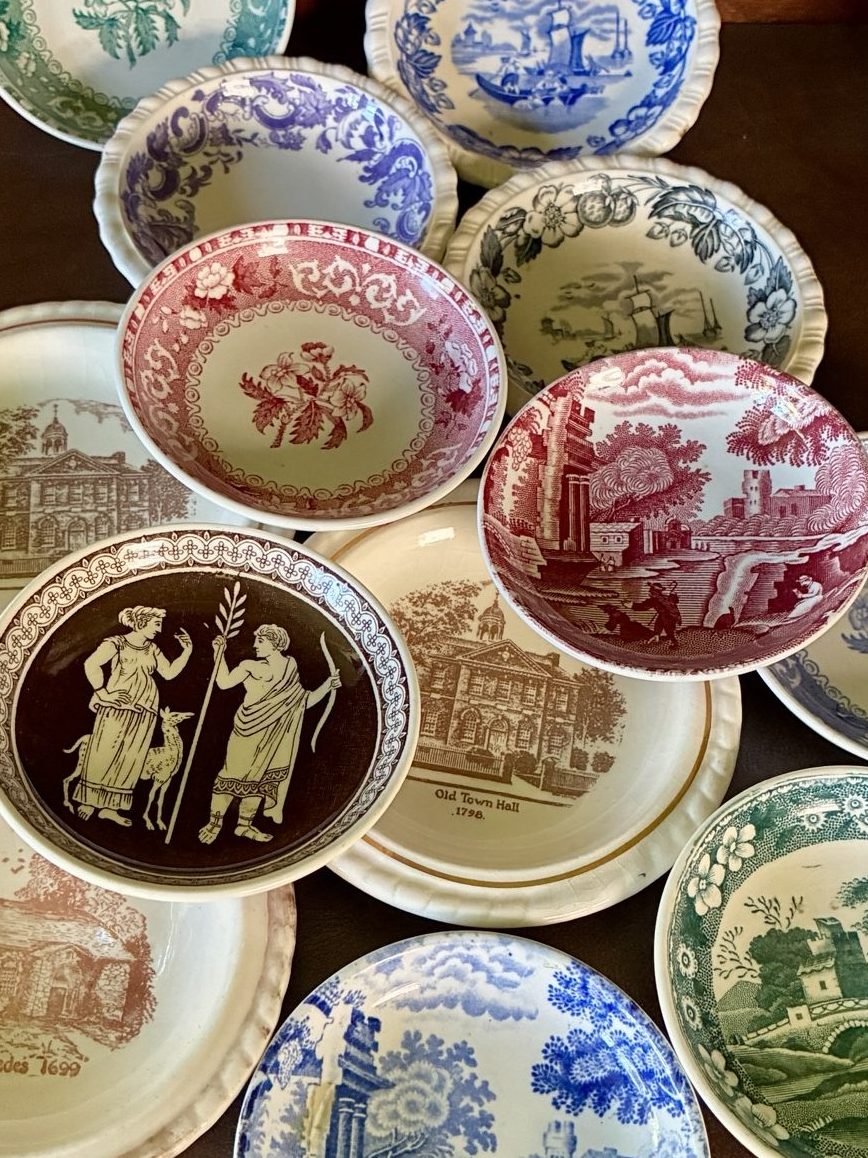
Selections of original Copeland Spode butter pats from the Grace Lloyd-Collins Christmas series.
The discovery that started the mystery
Then, in 2019, a dealer friend on the East Coast alerted me to a butter pat she thought I might want to see. She was right.
It was a green Copeland “Spode’s Tower” butter pat. The front was immediately recognizable. It was the reverse that changed everything. Along with the expected Spode markings was an underglaze Christmas greeting:
“To Wish You Merry Christmas
Grace Lloyd-Collins”
I had never seen one. Here was one of Spode’s classic patterns, but instead of being simply another variation for my growing butter pat collection, this little dish had apparently been made for a specific person, for a specific purpose, in America.


Green Copeland Spode Tower butter pat, showing the pattern on the front and Grace Lloyd-Collins Christmas greeting on the reverse.
I wanted to know who Grace Lloyd-Collins was. And, perhaps predictably for a collector, I wanted to find another one.
Who was Grace Lloyd-Collins?
My search eventually led to Wilmington, Delaware, and to businesswoman Grace Lloyd Collins Walsh, who operated a gift shop there during the middle decades of the twentieth century.
More importantly for my purposes, it led to the University of Delaware, whose Special Collections holds a remarkable collection of 74 commemorative butter pat dishes associated with Lloyd Collins Walsh and her shop. The collection dates the dishes from the 1930s through the 1950s. Most bear Spode marks.
According to the University’s collection description, represented Spode patterns include Old Salem, Tower, Camilla, Italian, Castle and Beverley, produced in brown, black, purple, blue, red and green. Almost all carry an underglaze Christmas greeting on the reverse. Most read:
“To Wish You Merry Christmas
Grace Lloyd-Collins”
The University collection provides evidence that the tradition continued for years. Examples depicting Old Swedes Church carry the more specific inscription “Best Wishes for 1947 / Grace Lloyd-Collins.” Five Castle butter pats read “To Wish You Merry Christmas / Lloyd-Walsh,” apparently dating them after Grace Lloyd Collins’ 1951 marriage to Robert Walsh.
Suddenly my little green Tower dish was part of a much larger story and my search for them became considerably more serious.


Copeland Spode butter pat patterns featuring the Christmas sentiment from Grace Lloyd-Collins printed on the back of each dish.
The hunt
In the years since finding that first green Tower butter pat, I have continued looking for Lloyd-Collins examples wherever Spode might turn up — antiques shops and shows, dealers, online auctions and, increasingly, listings where the seller may not realize what is written on the reverse of a three-inch dish.
The search is part of the pleasure.
Today, my collection includes 12 examples or variations:
| Pattern | Colors |
|---|---|
| Camilla | Pink, Green and Blue |
| Tower | Green |
| Italian | Blue and Pink |
| Old Salem | Blue and Black |
| Beverly | Mulberry |
| Greek | Brown |
| Old Town Hall 1798 | Brown |
| Old Swedes 1699 | Brown |
The two Wilmington architectural subjects are particularly interesting. The University of Delaware collection contains several dishes depicting historic Wilmington buildings, including Old Town Hall and Old Swedes Church. Unlike most of the collection, these are unmarked. The University’s description suggests they may be Wilmington Tercentenary commemoratives made by Spode and sold by Lloyd Collins Walsh, although Josiah Wedgwood & Sons is also identified as a possible manufacturer.


Commemorative butter pats depicting Old Town Hall (1798) and Old Swedes Church (1699) in Wilmington, Delaware, with their respective reverses.
There are still questions to be answered. One of the most intriguing sits in my own collection.
My brown Greek pattern example does not appear among the six Spode patterns specifically identified in the University of Delaware collection description. I hesitate to call it an undocumented pattern without further research — there likely are other examples in private collections or records not reflected in the University’s summary — but its presence raises exactly the kind of question that keeps collectors searching.
How many different patterns were produced for Grace Lloyd-Collins? How many colors? Were different patterns selected for different years? How large were the individual orders? And how many variations remain unidentified in collections on either side of the Atlantic? Perhaps another collector our there knows?
Back to Christmas Tree
As my collection grew, another acquisition made me look at the Lloyd-Collins butter pats somewhat differently.
I acquired an original early Spode Christmas Tree plate dating to 1938. It, too, carries a Christmas sentiment on the reverse. The story goes that this early Christmas Tree piece was created to promote sales to American retailers during the Great Depression. The enthusiastic response to this new Christmas pattern helped launch what would become an extraordinary commercial success and, ultimately, an American Christmas tradition. For me, the visual connection was irresistible.
On one side was an early Christmas Tree plate, produced in England and promoted to the American retail trade with a holiday message on its reverse.


Early Spode Christmas Tree dinner plate dated 1938, with its Christmas greeting on the reverse.
On the other were small dishes carrying some of Spode’s classic English patterns — Tower, Camilla, Italian, Old Salem and others — accompanied by another Christmas message and the name of an American retailer.
I don’t suggest that one necessarily led to the other. But they belong to the same fascinating chapter of Spode history: the relationship between an English pottery and an American market that embraced Spode not simply as tableware, but as part of its traditions. And Christmas seems to have played an unusually important role in that relationship.
Collecting Spode in America
Perhaps that is why this particular collecting quest resonates with me. My own relationship with Spode began with a pattern created for America and associated almost entirely with Christmas.
Years later, after my interests had expanded into antique transferware and obscure forms, Christmas unexpectedly found its way back into my collection — this time through three-inch butter pats made for a Wilmington shopkeeper decades ago.
There is also something distinctly American about the story.
An English manufacturer with more than a century of history supplied a Delaware businesswoman with tiny examples of its classic patterns. She transformed them into personal Christmas greetings for her customers. Those customers took them home. Some presumably used them. Others tucked them into cupboards and china cabinets.
Decades passed.
Eventually they began appearing at estate sales, antiques shops and online marketplaces, separated from the people who originally received them and often from the story that explained the inscription on their backs. And then collectors began finding them again.
That, for me, is one of the great pleasures of collecting Spode in America. We are separated from Stoke-on-Trent by an ocean, and often separated from the original manufacture of the pieces we collect by a century or more. Yet objects have a remarkable ability to preserve connections that otherwise disappear.
Sometimes the object is a magnificent platter or an important early piece.
And sometimes it is a three-inch butter pat.
My search for the Grace Lloyd-Collins Christmas butter pats continues. I would particularly like to learn whether other patterns or color combinations exist beyond those documented by the University of Delaware and those now represented in my collection.
So I end with an invitation to fellow Spode Society members and collectors: turn over your butter pats.
There may be another Christmas greeting — and another piece of this story — waiting there.
A earlier version of article was originally published in the Fall/Winter 2026 issue of The Spode Society Review. This version is reproduced here as part of From My Collection at The Sophisticated Picker.
I welcome hearing from fellow collectors who have encountered Grace Lloyd-Collins Christmas butter pats, particularly examples in additional patterns or colors.
Leave a Reply